Śrāddha or Shraaddha is a Sanskrit word which literally means anything or any act that is performed with all sincerity and faith (Śraddhā). In the Hindu religion, it is the ritual that one performs to pay homage to one's 'ancestors', especially to your deceased parents.
I go home twice a year to do the shraadham for my parents. For me it is not a religious trip, I go back to tell them that I continue to miss them every single day and they could have stayed back for some more time, just a bit more.
My mom passed away 12 years back and my father 7 years back. When they were at home, we had a reason to go home. Now we make this as one of the reasons to go back home.
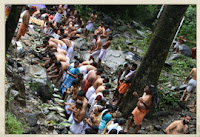 Shraadham is a small ceremony done in certain temples or at home. I prefer to do it in Thrichambaram temple close to my home. My younger brother prefers to do it at Tirunelli, the only temple in the world where the devotees can perform all the rituals related to one’s life, starting from birth to death and life after death. One of my elder brothers prefers to do it in Tirunavaya, a very sacred place for the Hindus of Kerala from time immemorial. Wherever we do it, we get to do it together, talk about our parents and it becomes a trip back to our childhood.
Unfortunately, this March, my brothers couldn't make it to my father's Shraadham. So, my husband accompanied me. My mother-in-law strongly believes that once you do the shraadham in Tirunelli, you don't have to do it year after year. She and her siblings get together twice a year at their ancestral home which I think is really nice. Though we have done the Shraaddham in Tirunelli, I feel the need to do it as long as I am able to. I guess, it is more for me and not for my parents!
For us, the shraaddham starts the day before the actual day, which falls on the same star of the malayalam month. Shraaddham doesn't usually fall on the same date every year. The day before, we observe "orikkal" which means once. Being predominantly rice eaters, we restrict ourselves to rice once a day and hence the name orikkal.

 Shraaddham is done early in the morning and it is always done near a waterbody. This year, I did my father's shraaddham at Thrichambaram temple. There is a small pond known as "pindakkulam" - "pindam" in malayalam means the offering to the ancestors which includes cooked rice and "kulam" means pond and hence the name pindakulam.
You are expected to take three dips in the pond or river or pour water over your head from the well if you are doing it at home. I took three dips in "Vishnuteertham", it is a beautiful pond with a lot of lotus flowers. This used to be a common bathing pool in my childhood for us, but no more.
 The rituals are done in wet clothes and it is a very simple one. You would usually see the following for a shraaddham- black sesame seeds, Cooked rice, Yogurt (you may not see this in some temples), flowers, Sandal wood paste, Kusha grass and Kindi, a typical brass vessel to hold water. The local priest guides you through the process and tells you to do the various offerings. For me, the most difficult part of the process is when he asks you who you are doing the shraddham for. It breaks my heart to say my parents' name year after year. I blindly go through the process as he instructs and I never remember the order in which the offerings are to be made. He, then asks you to pray for their "mukti", redemption. I keep asking them for forgiveness if I have hurt them in anyway.
 I go back to "vishnuteertham" for another set of three dips and from there to the temple in wet clothes to pray. Praying in the temples in wet clothes used to be a common practice in Kerala temples. I feel relieved and at peace when I do the shraaddham. I get to meet my brothers and they remind me of my parents. There is something from each parent that I can see in them and we keep comparing.
I don't know if the Malayalee, Hindu, Nair customs dictate you to do Shraaddham every year. I do it because it allows me to keep my favourite memories alive and meet my favourite people. That explains why I do it year after year.
https://en.wikipedia.org/wiki/Śrāddha
http://www.thirunellitemple.com
https://en.wikipedia.org/wiki/Tirunavaya
https://www.keralatourism.org/malayalam-calendar
http://panchatheertha.org/download/Pitru_pooja_2.html
I go home twice a year to do the shraadham for my parents. For me it is not a religious trip, I go back to tell them that I continue to miss them every single day and they could have stayed back for some more time, just a bit more.
My mom passed away 12 years back and my father 7 years back. When they were at home, we had a reason to go home. Now we make this as one of the reasons to go back home.
 Shraadham is a small ceremony done in certain temples or at home. I prefer to do it in Thrichambaram temple close to my home. My younger brother prefers to do it at Tirunelli, the only temple in the world where the devotees can perform all the rituals related to one’s life, starting from birth to death and life after death. One of my elder brothers prefers to do it in Tirunavaya, a very sacred place for the Hindus of Kerala from time immemorial. Wherever we do it, we get to do it together, talk about our parents and it becomes a trip back to our childhood.
Unfortunately, this March, my brothers couldn't make it to my father's Shraadham. So, my husband accompanied me. My mother-in-law strongly believes that once you do the shraadham in Tirunelli, you don't have to do it year after year. She and her siblings get together twice a year at their ancestral home which I think is really nice. Though we have done the Shraaddham in Tirunelli, I feel the need to do it as long as I am able to. I guess, it is more for me and not for my parents!
For us, the shraaddham starts the day before the actual day, which falls on the same star of the malayalam month. Shraaddham doesn't usually fall on the same date every year. The day before, we observe "orikkal" which means once. Being predominantly rice eaters, we restrict ourselves to rice once a day and hence the name orikkal.

 Shraaddham is done early in the morning and it is always done near a waterbody. This year, I did my father's shraaddham at Thrichambaram temple. There is a small pond known as "pindakkulam" - "pindam" in malayalam means the offering to the ancestors which includes cooked rice and "kulam" means pond and hence the name pindakulam.
 You are expected to take three dips in the pond or river or pour water over your head from the well if you are doing it at home. I took three dips in "Vishnuteertham", it is a beautiful pond with a lot of lotus flowers. This used to be a common bathing pool in my childhood for us, but no more.
 The rituals are done in wet clothes and it is a very simple one. You would usually see the following for a shraaddham- black sesame seeds, Cooked rice, Yogurt (you may not see this in some temples), flowers, Sandal wood paste, Kusha grass and Kindi, a typical brass vessel to hold water. The local priest guides you through the process and tells you to do the various offerings. For me, the most difficult part of the process is when he asks you who you are doing the shraddham for. It breaks my heart to say my parents' name year after year. I blindly go through the process as he instructs and I never remember the order in which the offerings are to be made. He, then asks you to pray for their "mukti", redemption. I keep asking them for forgiveness if I have hurt them in anyway.
  I go back to "vishnuteertham" for another set of three dips and from there to the temple in wet clothes to pray. Praying in the temples in wet clothes used to be a common practice in Kerala temples. I feel relieved and at peace when I do the shraaddham. I get to meet my brothers and they remind me of my parents. There is something from each parent that I can see in them and we keep comparing.
 I don't know if the Malayalee, Hindu, Nair customs dictate you to do Shraaddham every year. I do it because it allows me to keep my favourite memories alive and meet my favourite people. That explains why I do it year after year.
https://en.wikipedia.org/wiki/Śrāddha
http://www.thirunellitemple.com
https://en.wikipedia.org/wiki/Tirunavaya
https://www.keralatourism.org/malayalam-calendar
http://panchatheertha.org/download/Pitru_pooja_2.html


